Skip to content
For health plans, health systems and state agencies

Benchmark fee schedules and plan payment against every other state.

Cross-state benchmarks by service and provider level, Medicare comparisons, directed-payment levels and capitation where published, with every figure linked to the state document behind it.

7-day free trial · Cancel any time · Every number linked to its source

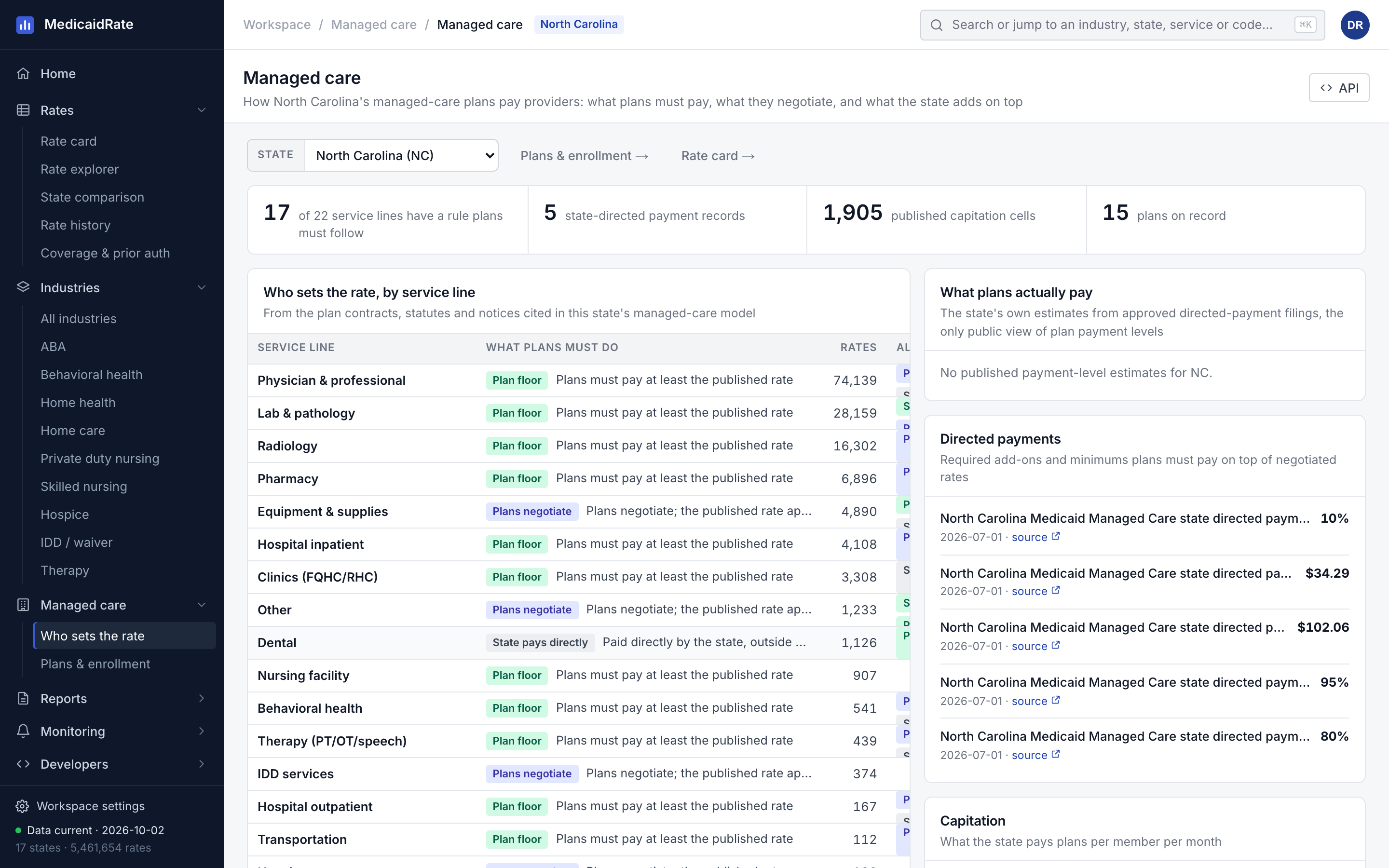
Managed-care view showing who sets the rate by service line
Jurisdictions
51
All 50 states and DC
Rates on file
10,066,914
Every version, effective-dated
Billing codes
65,914
CPT, HCPCS and state codes
Official sources
8,463
Fee schedules, notices, contracts
Rate changes tracked
18,804
Proposed and enacted
Workflow

How teams use MedicaidRate

  1. Pick the services under review

    Choose the codes or service lines a contract, rate review or network decision depends on.

  2. Benchmark across states

    Rank your state against peers like for like, and read physician codes as a percent of Medicare.

  3. Read the managed-care layer

    See which states bind plan payment, which set rates directly, and what directed payments add.

  4. Pull the data into your models

    Export reports to CSV or PDF, or load full extracts and API data into actuarial and analytics tools.

Use cases

Where it makes a difference

01

Health plans: network contracting and rate reviews

Plan contracting teams need to know where their offers sit against the state fee schedule and against what the state requires. Where a contract or statute sets a floor or requires a pass-through of a state increase, the managed-care view shows it by service line with the source language, which helps contracting and compliance work from the same reading.

When a plan enters a new state, cross-state benchmarks show how that state's fee schedule compares with the states the plan already serves, service by service.

02

Health systems: payer mix and Medicaid strategy

For a health system, Medicaid is often the largest payer by volume and the lowest by rate. The rate card shows physician and professional codes as a percent of the Medicare physician fee schedule, so the gap can be measured code by code. Directed payments, which in many states add substantially to hospital and physician payment, are listed with the payment levels the state reported.

Rate changes in peer states are a useful signal of where policy is heading. The changes feed tracks proposed and enacted changes across states with their status and effective date.

03

State agencies: peer-state benchmarking

Rate reviews, access analyses and legislative requests usually start with the same question: how does our state compare? MedicaidRate holds current and historical rates for all 50 states and DC, matched by unit and provider level, so a peer comparison can be built without collecting every other state's schedule first.

Each figure links to the other state's own document, so analysts can verify a comparison at the source before it goes into a report.

Data you get

Seven layers of Medicaid payment, one dataset

All 50 states and DC, versioned by effective date, with the official document behind every value.

  • Fee-for-service ratesEvery state fee schedule by code, modifier, program, provider level and region, effective-dated with full history.
  • Managed-care rulesWhat plans must pay: contract and statute floors, pass-throughs of state increases and state-set rates, tagged on each rate they govern.
  • Directed paymentsApproved directed payments, uniform add-ons and minimum fee schedules, with the payment-level estimates states file with them.
  • Coverage and prior authorizationCovered, prior-authorization and unit-limit rules by state, program and plan, where published.
  • Rate changesProposed, enacted, approved and effective changes from notices, plan amendments and budgets, with status, effective date and comment deadline.
  • Medicare comparisonThe Medicare physician fee schedule for the same code, and each Medicaid rate as a percent of Medicare.
  • Commercial & TRICARE payer ratesWhat commercial payers, Medicare Advantage plans and TRICARE pay for the same codes, as medians with sample sizes, unit-normalized and beside Medicaid.
  • Wages and labor costsBLS wages for the roles that deliver each service, benefits, and state minimum wage with history and scheduled increases.

Plans do not publish negotiated provider fee schedules, so no public source contains them. How we source and verify rates

FAQ

Questions from health plans, systems & states

Which states are covered?

All 50 states and the District of Columbia, with fee-for-service rates, managed-care rules and rate changes. The depth of history and managed-care detail varies by what each state publishes.

Do you include capitation rates?

Yes, per-member-per-month rates by region and rate cell where states publish them.

What is a directed payment, and why does it matter?

A directed payment is a federally approved arrangement in which the state requires plans to pay providers in a set way, such as a uniform increase or a minimum fee schedule. In many states it is a large share of what certain providers receive, and the filings often include the state's estimate of payment levels relative to Medicare or commercial.

Can our analysts get the full dataset?

Enterprise includes bulk data delivery for up to 50 analysts. If you also need programmatic access, the API plan adds API keys and the REST API.

Do you support SSO?

SSO is coming soon on Enterprise.

Is there a free trial?

Yes. Every account starts with 7 days of full access. A card is required, you are not charged during the trial, and you can cancel any time before it ends.

For health plans, health systems and state agencies

Every number linked to its source.

Start a 7-day free trial with full access. You won't be charged until it ends, and you can cancel any time before then.