Skip to content
For billing, RCM and EVV software

Current Medicaid rates in your product, through one API.

Effective-dated rates by state, code, modifier, program and payer, with stable ids, change events, coverage and prior-authorization rules, and a reference with cURL, Python and Node examples.

7-day free trial · Cancel any time · Every number linked to its source

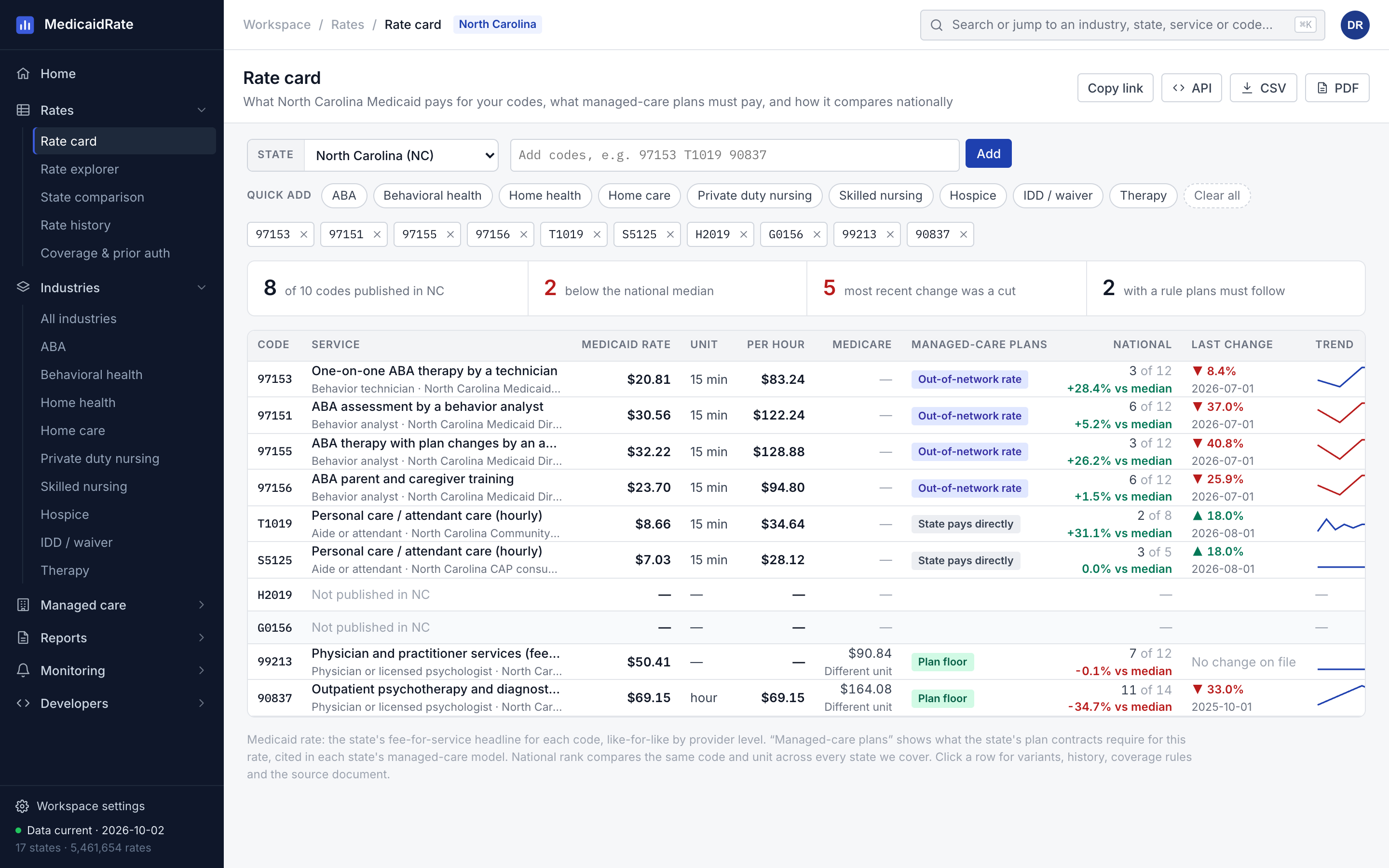
Rate card with its equivalent API request
Jurisdictions
51
All 50 states and DC
Rates on file
10,066,914
Every version, effective-dated
Billing codes
65,914
CPT, HCPCS and state codes
Official sources
8,463
Fee schedules, notices, contracts
Rate changes tracked
18,804
Proposed and enacted
Workflow

How teams use MedicaidRate

  1. Explore in the console

    Send live requests from the workspace, see real responses and copy the equivalent code.

  2. Map your codes

    Query rates by state, code, modifier, program and provider type. Each rate has a stable id you can store.

  3. Sync by effective date

    Pull what is in effect today, or pass as_of for a date of service. Use the changes endpoint to pick up what moved since your last sync.

  4. Go to production

    Start the API plan: API keys, unlimited requests, signed rate-change webhooks and an SLA.

Use cases

Where it makes a difference

01

Expected-payment checks in billing and RCM

Underpayments are hard to catch when the expected rate lives in a spreadsheet someone updated last year. Medicaid rates are effective-dated, and a claim should be checked against the rate in effect on its date of service, not today's rate.

Every MedicaidRate rate endpoint accepts an as_of date and returns the rate in effect on that day, with its unit, modifier, program and provider level. Pass include_history to get every published version. Each rate has a stable id and links to its source document, so an exception can be explained to a client without a phone call.

02

Rate tables in EVV and agency software

EVV and agency-management platforms that serve home care, personal care and IDD providers need the current rate for each service code and modifier in every state they sell into. Keeping those tables current by hand across dozens of states is a standing cost.

The changes endpoint returns what moved, filtered by state, code, status and publish date, so a nightly job can pick up new rates without re-downloading everything. Proposed changes appear before they take effect, which gives a product team time to warn customers.

03

Coverage and prior-authorization rules at intake

Whether a service is covered, needs prior authorization or has a unit limit depends on the state, the program and sometimes the plan. The coverage endpoint returns those rules where they are published, so intake and scheduling screens can flag an authorization requirement before a visit is delivered rather than after a denial.

Data you get

Seven layers of Medicaid payment, one dataset

All 50 states and DC, versioned by effective date, with the official document behind every value.

  • Fee-for-service ratesEvery state fee schedule by code, modifier, program, provider level and region, effective-dated with full history.
  • Managed-care rulesWhat plans must pay: contract and statute floors, pass-throughs of state increases and state-set rates, tagged on each rate they govern.
  • Directed paymentsApproved directed payments, uniform add-ons and minimum fee schedules, with the payment-level estimates states file with them.
  • Coverage and prior authorizationCovered, prior-authorization and unit-limit rules by state, program and plan, where published.
  • Rate changesProposed, enacted, approved and effective changes from notices, plan amendments and budgets, with status, effective date and comment deadline.
  • Medicare comparisonThe Medicare physician fee schedule for the same code, and each Medicaid rate as a percent of Medicare.
  • Commercial & TRICARE payer ratesWhat commercial payers, Medicare Advantage plans and TRICARE pay for the same codes, as medians with sample sizes, unit-normalized and beside Medicaid.
  • Wages and labor costsBLS wages for the roles that deliver each service, benefits, and state minimum wage with history and scheduled increases.

Plans do not publish negotiated provider fee schedules, so no public source contains them. How we source and verify rates

FAQ

Questions from billing & evv software

What does the API return?

JSON. Rates with state, code, modifier, program, provider level, unit, amount, effective dates, managed-care rule and source document, plus endpoints for comparisons, history, changes, coverage, managed care, Medicare and wage reference data.

How do I get the rate for a past date of service?

Pass as_of=YYYY-MM-DD to any rate endpoint. By default endpoints return what is in effect today.

How do I keep my copy in sync?

Store each rate's stable id, then poll the changes endpoint with a since date to pick up new, enacted and effective changes, or add a webhook endpoint (API plan) and we POST each rate change to you, signed with HMAC-SHA256.

Can I try the API before buying?

The API plan itself starts paid, with no trial. The 7-day free trial on Operator, Professional and Enterprise includes the API console in the workspace, which shows the request behind each view and generates code, so you can see every endpoint and response before you subscribe.

Is there a bulk export?

Yes. Bulk data delivery is included in Enterprise and in the API plan, for teams that want full extracts rather than API calls.

Do you include CPT descriptors?

No. Rates are keyed by code. Your system supplies its own licensed code descriptions.

For billing, RCM and EVV software

Every number linked to its source.

Start a 7-day free trial with full access. You won't be charged until it ends, and you can cancel any time before then.