Skip to content
For provider organizations

Know what Medicaid pays you, and what plans must pay, in every state you serve.

ABA, home care, behavioral health, home health, private duty nursing, IDD, skilled nursing, hospice and therapy providers use MedicaidRate to see the rate for each code they bill, the rules managed-care plans must follow, and every proposed change before it takes effect.

7-day free trial · Cancel any time · Every number linked to its source

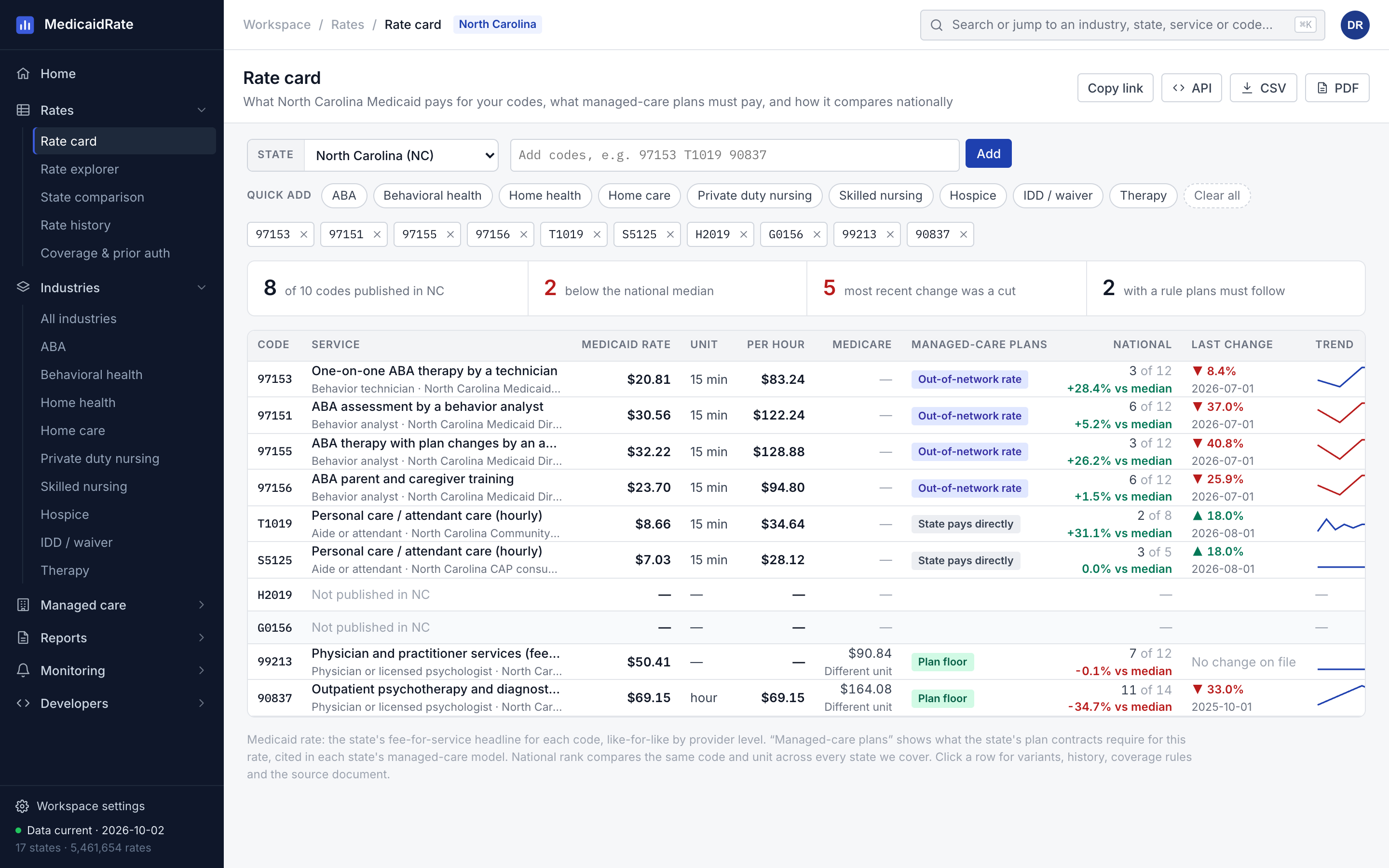
Rate card showing one state's Medicaid rates for a provider's billing codes, with managed-care rules and national rank
Jurisdictions
51
All 50 states and DC
Rates on file
10,066,914
Every version, effective-dated
Billing codes
65,914
CPT, HCPCS and state codes
Official sources
8,463
Fee schedules, notices, contracts
Rate changes tracked
18,804
Proposed and enacted
Workflow

How teams use MedicaidRate

  1. Pick your state and codes

    Choose the state you operate in and the billing codes you use. Setup takes about a minute, and the rate card remembers them.

  2. Read your rate card

    See each code's current rate, unit, per-hour equivalent, managed-care rule, national rank and the date it last changed.

  3. Watch for changes

    Check the changes feed for notices, plan amendments and budget actions that touch your service lines, with effective dates and comment deadlines.

  4. Bring evidence to the table

    Export the rate card, a state comparison or a labor-cost view to CSV or PDF for a plan negotiation, a board meeting or an association letter.

Use cases

Where it makes a difference

01

Negotiating with managed-care plans

In most states the majority of Medicaid members are enrolled in managed-care plans, and those plans do not publish what they pay providers. That leaves many providers negotiating without knowing the one number that matters most: the minimum the plan is required to pay.

MedicaidRate tags each rate with the managed-care rule that governs it. Where a state contract or statute requires plans to pay at least the fee schedule, to pass through a legislated increase, or to use a state-set rate, the rate card says so and links to the contract or notice that requires it. Where the state has an approved directed payment, such as a uniform add-on or a minimum fee schedule, it shows the payment level and the state's own filing.

A plan offer below a binding floor is a compliance question, not a negotiating position. Knowing which of your codes are covered by a floor, and which are genuinely open, changes how you spend your time at the table.

02

Getting ahead of rate cuts and increases

Medicaid rates change through public notices, state plan amendments, waiver amendments, provider bulletins and budget bills, and the comment window on a proposed cut is often short. Providers that hear about a change from a remittance advice have already missed the chance to respond.

The changes view collects proposed, enacted and effective changes in one feed, with the status, the effective date, the codes affected and the comment deadline where one is published. Filter it to your state and service lines, then open the source notice in one click.

03

Checking whether a rate still covers the work

For hourly services such as personal care, ABA, private duty nursing and IDD supports, the question is not just what the rate is but whether it still covers a direct-care wage. The industry view converts each rate to a per-hour figure and sets it beside BLS wages for the roles that deliver the service and the state minimum wage, including scheduled increases.

The margin-per-hour calculator lets you enter your own wage and overhead assumptions to see what is left. It is the same evidence associations use in rate-increase requests, built for a single agency's numbers.

Data you get

Seven layers of Medicaid payment, one dataset

All 50 states and DC, versioned by effective date, with the official document behind every value.

  • Fee-for-service ratesEvery state fee schedule by code, modifier, program, provider level and region, effective-dated with full history.
  • Managed-care rulesWhat plans must pay: contract and statute floors, pass-throughs of state increases and state-set rates, tagged on each rate they govern.
  • Directed paymentsApproved directed payments, uniform add-ons and minimum fee schedules, with the payment-level estimates states file with them.
  • Coverage and prior authorizationCovered, prior-authorization and unit-limit rules by state, program and plan, where published.
  • Rate changesProposed, enacted, approved and effective changes from notices, plan amendments and budgets, with status, effective date and comment deadline.
  • Medicare comparisonThe Medicare physician fee schedule for the same code, and each Medicaid rate as a percent of Medicare.
  • Commercial & TRICARE payer ratesWhat commercial payers, Medicare Advantage plans and TRICARE pay for the same codes, as medians with sample sizes, unit-normalized and beside Medicaid.
  • Wages and labor costsBLS wages for the roles that deliver each service, benefits, and state minimum wage with history and scheduled increases.

Plans do not publish negotiated provider fee schedules, so no public source contains them. How we source and verify rates

FAQ

Questions from provider organizations

Which provider types does MedicaidRate cover?

Every service line a state publishes, including ABA, behavioral health, home care and personal care, home health, private duty nursing, IDD and waiver services, skilled nursing, hospice, therapy, physician services, dental, DME and transportation. Dedicated industry views cover nine provider industries.

Can I see what a specific managed-care plan pays me?

No plan publishes its negotiated provider fee schedule, so no public source can show it. MedicaidRate shows everything that is public: the rules plans must follow, the rates the state sets for them, directed payments and the state's own estimates of plan payment levels.

How do I know a rate is current?

Every rate carries its effective date and a link to the source document it came from. Superseded rates are kept as history, so you can also see what was in effect on any past date of service.

Can I track more than one state?

Operator covers one state. Professional covers every state and adds state comparison, revenue impact modeling and reports.

Will I get an email when my rates change?

Yes. Follow the codes you bill and the states you work in, and we email you when a state changes one of those rates (old rate, new rate, effective date and the state's source), or posts a proposed or enacted change that names them. You can also get a weekly digest, or turn emails off, in Alerts.

Is there a free trial?

Yes. Every account starts with 7 days of full access. A card is required, you are not charged during the trial, and you can cancel any time before it ends. Public state and industry rate pages are always free.

For provider organizations

Every number linked to its source.

Start a 7-day free trial with full access. You won't be charged until it ends, and you can cancel any time before then.